
B2B solutions — infrastructure and major facilities
A later stage on the roadmap (years 2–3) — the "Kashf Master" tool is ready to try now
Leak detection for fire-water networks and buried main lines, and maintenance contracts for major facilities
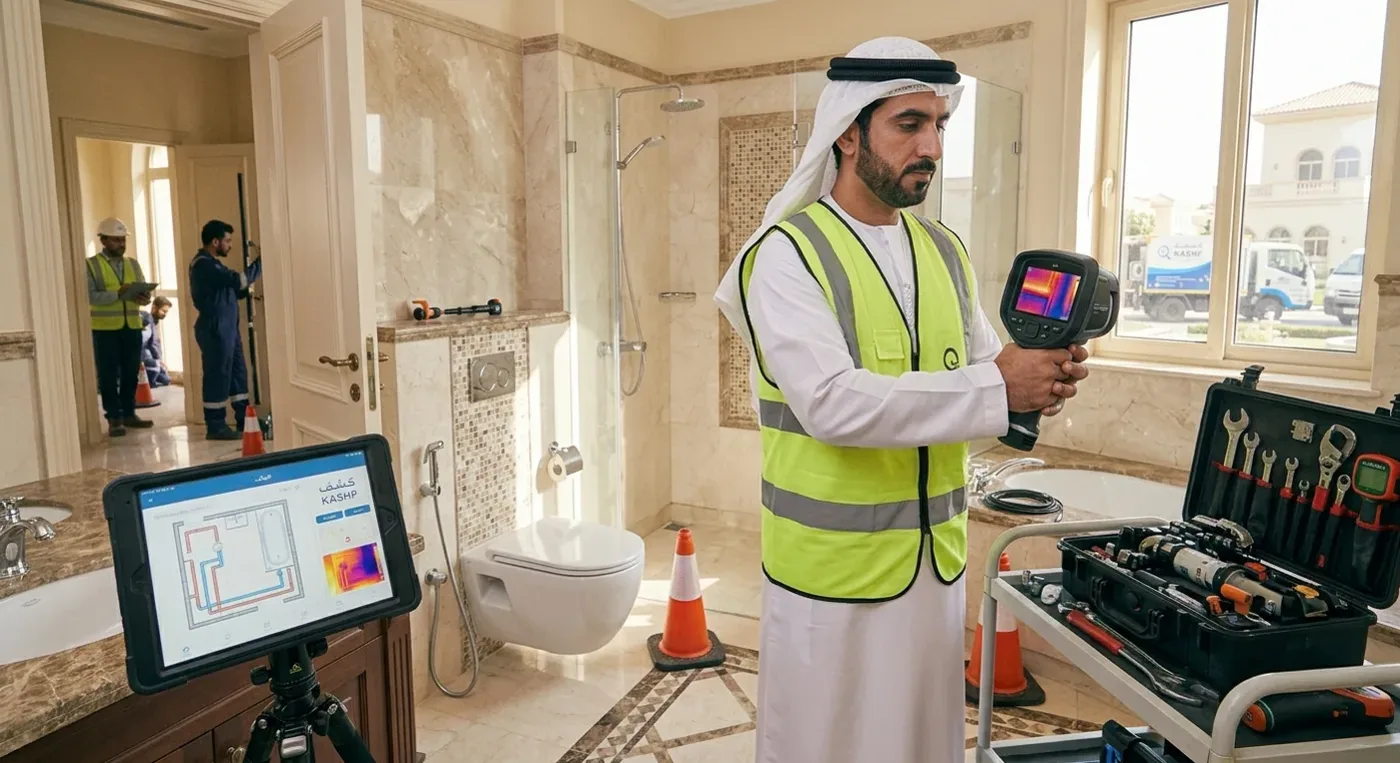
This page is aimed at those who manage infrastructure at a scale larger than a single building: a facilities manager of an industrial plant, a safety officer in a building subject to fire-water requirements, a project contractor needing a pressure test before handover, or an entity planning a periodic maintenance contract for an extended water network. This page complements the commercial and compounds services page with a deeper focus on three specific technical tracks: fire-water networks, main lines buried underground and in streets, and hydrostatic pressure testing with periodic maintenance contracts.
Three main service tracks
- Fire-water networks and their supply sources: Leak detection in supply lines and tanks connected to firefighting systems, without affecting system readiness during inspection.
- Buried main lines and street networks: Locating a leak in a buried line at great depth or distance, without random exploratory digging that damages pavement or finishes.
- Hydrostatic pressure testing and maintenance contracts: Integrity testing of a complete network before handover, or as part of scheduled periodic maintenance for major factories, hospitals, and compounds.
Equipment and technologies used — a simplified scientific explanation
Inspection at this project scale relies on physical measurement tools known worldwide in the leak-detection industry, not on guesswork or exploratory breaking. Below are the most prominent of these technologies and how they are used in practice:
Acoustic Correlator
A device places two sensors at two points on the pipeline on either side of the suspected area, and records the sound wave produced by the vibration of pressurized leaking water through the pipe wall. Knowing the speed of sound in the material type and the distance between the sensors, the device computes the time difference between the sound's arrival at each sensor to mathematically locate the leak between the two points — the standard method for locating leaks in long, deeply buried main lines.
Surface thermal and acoustic detection
A thermal imaging camera detects temperature differences caused by leaked moisture beneath roofs, walls, or floors, while ground microphones pick up the sound of pressurized leaking water through the ground or pavement surface directly. Combining the two methods narrows the suspected area before any actual intervention, which is especially useful in paved or covered areas where repeated exploratory digging is difficult.
Hydrogen Tracer Gas
In cases where sound alone cannot be relied upon (plastic lines that do not transmit vibration well, or high ambient noise), a safe mixture of hydrogen at a very low concentration with a carrier gas (usually nitrogen) is pumped into the temporarily drained line. Hydrogen is a very small molecule that escapes through the finest cracks and rises through the soil or pavement to the surface, where a specialized gas detector captures it above the line path with high spatial accuracy.
Hydrostatic Pressure Test
A standard field test in which the section to be inspected is filled completely with water, then the pressure is raised gradually to a specified level above normal operating pressure and held for a defined period while any drop in the pressure reading is monitored. Any abnormal pressure drop during the hold period indicates a leak or weak point in the network that requires further verification before commissioning the line or final project handover.
Certifications and trust
C.R. 1010824507 — Al-Azl Al-Haseen Contracting Est. We operate in accordance with the Commercial Registration and Value Added Tax regulations in force in the Kingdom, and our team is qualified to work according to the sector's approved safety requirements when dealing with sensitive facilities and networks such as fire-water tanks and sources.
We use specialized scientific measurement equipment (acoustic correlation, thermal imaging, ground listening, and safe tracer gas when needed) that provides high accuracy based on specialized scientific equipment in locating leaks, instead of relying on guesswork or random exploratory digging. Every B2B project ends with a written technical report documenting the inspection points and results, valid for use in the facility's maintenance files or internal documentation.
For facilities subject to Civil Defense requirements (such as fire-water tanks), our role is to detect and repair leaks in the network and the tanks supplying the firefighting system, within our scope of work as an insulation and leak-detection contractor; we are not an accreditation or licensing body. The Civil Defense compliance certificate itself remains the responsibility of the specialized fire-safety systems engineer and the relevant official body. For more detail, see our guide on Civil Defense requirements for fire-water tanks.
Comparison: a methodical scientific detection approach versus traditional manual methods
| Criterion | Scientific detection method with specialized equipment (Kashf) | Traditional manual/guesswork methods |
|---|---|---|
| Locating the leak | Physical measurement (sound/heat/pressure/gas) narrows the scope before any digging | Repeated exploratory digging based on guesswork or general experience alone |
| Collateral damage | Limited, usually confined to the repair point after precise location | May include multiple openings in intact pavement or walls while searching |
| Documentation | A written technical report with measurement results for every inspection point | Often undocumented or only partially documented |
| Impact on facility operation | Can be scheduled in stages to reduce disruption during working hours | May require longer downtime due to repeated digging attempts |
| Suitability for long/deeply buried lines | Specifically suited to this type of network (acoustic correlation over long distances) | Difficult and often impractical on extended or deep lines |
This is a general methodological comparison between two categories of approach, not a promise of a specific result for every case; the condition, age, and material of each network affect the actual result.
Sectors we serve in this track
- Factories and warehouses: Industrial water networks and lines extended over wide areas, and fire networks linked to flammable stock.
- Hospitals and healthcare facilities: Sensitive inspection that respects continuity of operation and avoids affecting critical departments.
- Large residential complexes and compounds: Shared networks serving tens or hundreds of units, and main lines within the development.
- Government/municipal projects and contractors: Pre-handover pressure testing, and leak detection within facility-maintenance works for public projects.
Request a quote (RFP) for your project
Fill in the following details and WhatsApp will open with a message pre-filled with all the details, ready to send directly to our business-sector team. This data is not sent to any external CRM system; it only prepares the text of a WhatsApp message.